Sunday, December 1, 2013

What it's like to drive in Comoros: A Matador, A Bull, or the Cape

From Jack:
Comoros: A land of near misses
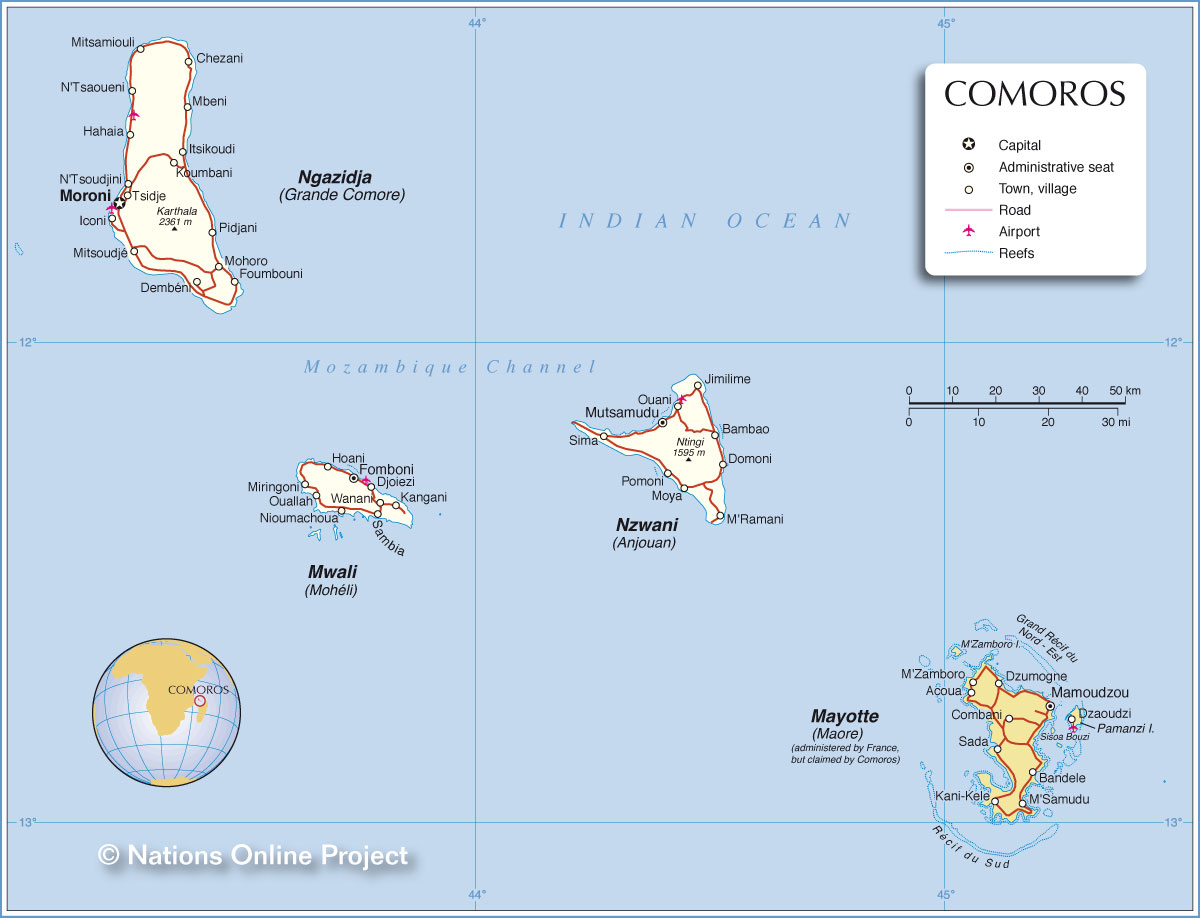
    I  traveled recently to Comoros--specifically Grand Comores (there are actually 3 islands that make up the state of Comoros: Grand Comores, Anjouan and Moheli--many Comorans claim Mayotte as part of the nation but currently it is an overseas department of France)--for work.


A billboard proclaims/admonishes along the coastline of Moroni:


"Mayotte is part of Comoros and always will be"


 I spent a week in its capital city Moroni, only venturing to the northern side of the island once.  Most of the week I had a driver (in Comoros and Madagascar, your rental car comes with a driver whether you desire one or not) but on a few days I had the opportunity to drive myself.  There's a plethora of things that one can write about the island and people of Comoros but for today I will discuss what it's like to drive in Comoros.  


Comoros is a country of near misses—if you are driving that is. 

You know how sometimes you can be driving somewhere in the US and you suddenly arrive at your destination with no recollection of how you got there?

This probably never happens to Comorans and certainly not to Americans driving there.

One cannot blithely drive down the roads in Comoros—zoned out and soaking in the lush green scenery (and the scenery is breath-taking--think north-side Kauai jungle).  By and large, the concept of a two-lane road is one that is foreign to Comoros. Sidewalks fall into that same category.  There are no shoulders, or drainage ditches in Comoros (with the exception of a FEW well-heeled neighborhoods perched in the high part of the city).

Driving anywhere in town is less an exercise in driving than in automotive hop-scotch—a constant series of dodges, accelerations, decelerations, stops, feints, and sphincter-puckering squeezes.   Your brain must be constantly calculating mental trigonomery to determine whether your vehicle or the one approaching will first reach the section of road only passable by one car at a time.  Another variable in this are the ubiquitous pedestrians (most Comorans don't own a vehicle) that are traveling down the same roads.   Finally add in the myriad potholes (some sections of road are less roads than long stretches of loosely connected potholes and craters) and heavy rainshowers and you have mathmatical calculations that exceed far beyond that of this English major.  All that said, the Comoran drivers that would zip past my slowly lumbering Toyota Prado were smoking butts and chatting distractedly as they nimbly navigated their vehicles centimers past mine with nary a furrowed brow.
As I parked the Prado in the hotel parking lot after my first jauunt, I thought of the person who would make the perfect driver in Comoros--the skilled, thrill-seeking matador.

For one must bravely face each oncoming car while calculating the exact time to pull back one's cape (i.e. veer to your right).  But I would venture that, drive long enough in Comoros, and sometimes you are instead the bull.  Matador, bull or cape--it is a decision you must make  hundreds of times during every two mile drive in Comoros. 

Friday, September 13, 2013

Ready to launch to Madagascar!

Today we purchased our final set of plane tickets and we are all set to head to Madagascar in just a few weeks!

This week we also received our visas which was the last administrative hurdle.  More to post here soon!

Thursday, April 4, 2013

Great Post from Djibouti Jones on 15 things to tell your children that are raised overseas (great parenting advice)

Great Post from Djibouti Jones on 15 things to tell your children that are raised overseas

I've cut and pasted a teaser of the first three below; you can check out the rest here.


  1. You are the coolest kids on the planet. You cliff-jump and climb up and then down into active volcanoes. You flew internationally on your own before becoming a teenager. You sleep under the stars on the beach and know how to pee on a toilet or in a hole or behind a bush or where-there-is-no-bush. 
  2. I know it is hard. I watched you, proud and teary, the first day of school when you didn’t know how to count to ten in French and on the first day of school in America when you didn’t know how to eat lunch in a cafeteria. I see your moments of hesitation when kids talk about something you don’t understand. I saw your shoulders droop that day you wore your traditional Djiboutian dress to church and then, once you saw how other kids were dressed, asked if you could take it off. I hear all three of you refer to a different place as home.
  3. I don’t know what it is like. I know what it is like to parent a TCK but I don’t know what it is like to bea TCK. I’ve read books and listened to talks and attended seminars but you are forging a path I have not walked. I’ve got your back and I’ve got a box full of Kleenex and an ache in my belly from our shared laughter. I do not know what your particular journey is like but I will hold your hand, fierce, until the very end.


LINKS:
http://www.djiboutijones.com/2013/03/1-things-i-want-to-tell-my-third-culture-kids/

Monday, February 25, 2013

Books about Madagascar


Here's a smattering of books about Madagascar that I lifted from the State Department website.


 Attenborough, David, Zoo Quest to Madagascar, Lutterworth Press, London, 1961.

Astuti, Rita,People of the Sea: Identity and Descent among the Vezo of Madagascar (Cambridge Studies in Social and Cultural Anthropology), Cambridge University Press, Cambridge, 2003.

Bloch, Maurice, Placing the Dead: Tombs, Ancestral Villages, and Kinship Organization in Madagascar, Seminar Press, New York, 1971.

Bourgeacq, Jacques, and Liliane Ramarosoa, Voices from Madagascar: An Anthology of Contemporary Francophone Literature, Ohio University Press, Athens, 2002.

Bradt, Hilary, Madagascar The Bradt Travel Guide - 7th ed., Globe Pequot Press, 2002.

Brown, Mervyn, A History of Madagascar, Marcus Wiener Publishers, Princeton, 2000.

Cole, Jennifer, Forget Colonialism? Sacrifice and the Art of Memory in Madagascar, University of California Press, Berkeley, 2001.

Dahl, Oyvind and Yvind Dahl, Meanings in Madagascar: Cases of Intercultural Communication, Bergin & Garvey, 1999.

Durrell, Gerald, The Aye-Aye and I: A Rescue Mission in Madagascar, Arcade, New York, 1993.

Ellis, Stephen, The Rising of the Red Shawls: A Revolt in Madagascar, 1895-1899, Cambridge University Press, Cambridge, 1985.

Evers, Sandra, and Marc Spindler, ed. Cultures of Madagascar: Ebb and Flow of Influences, Leiden, Netherlands, 1995.

Fitzpatrick, Mary, and Paul Greenaway, Lonely Planet Madagascar - 4th ed., 2001.

Garbutt, Nick, Mammals of Madagascar, Pica Press, 1999.

Goodman, Steven M. and Bruce D. Patterson, ed. Natural Change and Human Impact in Madagascar, Smithsonian Institution Press, Washington and London, 1997.

Goodman, Steven M. et al, ed. The Natural History of Madagascar, University of Chicago Press, (Jan. 2004).

Gow, Bonar, Madagascar and the Protestant Impact: The Work of the British Missions, 1818-1895, New York, 1979.

Jolly, Alison, A World Like Our Own: Man and Nature in Madagascar, Yale University Press, New Haven, 1980.

Kreamer, Christine Mulle, and Sarah Fee, Objects as Envoys: Cloth, Imagery, and Diplomacy in Madagascar, Smithsonian Institution, 2002.

Langrand, Olivier, Guide to the Birds of Madagascar, Yale University Press, New Haven, 1990.

Lanting. Frans, Madagascar: A World Out of Time, Aperture, New York, 1990.
Larson, Pier M., History and Memory in the Age of Enslavement: Becoming Merina in Highland Madagascar, 1770-1822, Heinemann, 2000.

Mack, John, Madagascar: Island of Ancestors, British Museum, London, 1986.

Mack, John, Malagasy Textiles, Shire Publications, 1989.

Mannoni, Octave, Prospero and Caliban: The Psychology of Colonization, Praeger, New York, 1956.

Mittermaier, Russell, et al. Lemurs of Madagascar, Conservation International, 1994.

Murphy, Dervla, Muddling Through in Madagascar, Overlook Press, 1985.
Tyson, Peter, The Eighth Continent: Life, Death and Discovery in the Lost World of Madagascar, Harper Collins, New York, 2000.

French
Acquier, Jean-Louis, Architecture de Madagascar, Arthaud, Paris, 1997.

La Cité des Mille: Antananarivo: Histoire, Architecture, Urbanisme, CITE/Tsipika, Antananarivo, 1998.

Cauvin, Patrick, Villa Vanille, Albin Michel, 1997.

De Flacourt, Etienne (annotated by Claude Alibert), Histoire de la Grande Ile Madagascar, Karthala, Paris, 1995.

Gallieni, Joseph, Neuf Ans à Madagascar, Hachette, Paris, 1908.

Guide Bleu Evasion, Madagascar, Hachette, Paris, 2001.

Guide Gallimard, Madagascar, 1999.

Randrianary, Victor, Madagascar: Les Chants d'une Ile, Cité de la Musique/Actes Sud, 2001.

Revel, Eric, Madagascar, L'Ile Rouge, Ballard, 1994.

Tronchon, Jacques, L'Insurrection Malgache de 1947, Karthala, Paris, 1987.

Verin, Pierre, Madagascar, Karthala, Paris, 1990.

Thursday, February 21, 2013

General Mills Initiative Helps Vanilla Farmers in Madagascar

General Mills Initiative Helps Vanilla Farmers in Madagascar 

“Contributing to the viability and sustainability of vanilla farming could have a significant impact on the lives of Malagasy growers, their communities, and the environment,” Steve Peterson, director of sourcing sustainability at General Mills, said.
Peterson added that vanilla “is the way of life for these people.” Through sharing their “supply chain expertise, while leveraging our financial resources,” General Mills can help create a higher-quality, more sustainable vanilla supply, while increasing the vanilla farmers’ living standards."

Read more here:


Sunday, February 3, 2013

From the Economist: Malagasy politics: Who will take over?

We are following the upcoming elections closely.  The opening from an excellent recent Economist article is below:

(NOTE: Malagasies is pronounced mahlahgaSHee)

"MALAGASIES have waited four years for a chance to vote for a government. In February 2009, Andry Rajoelina overthrew Madagascar’s president, Marc Ravalomanana, in an army-backed coup. Since then Mr Rajoelina has promised—and postponed—elections every year. But later this year the country will at last go to the polls; presidential and legislative elections have been scheduled for May 8th and July 3rd. But it is far from clear who will win the long-awaited vote."

Former President Ravalomanana


LINK:
http://www.economist.com/blogs/baobab/2013/01/malagasy-politics?fsrc=scn/tw/te/bl/whowilltakeover


Thursday, January 24, 2013

Queen Ranavalona Makes the Front Page (of Wikipedia)

Queen Ranavalona Makes the Front Page (of Wikipedia)

Wikipedia features a random article everyday on its home page and today's front page carried a story on the "Last Queen of Madagascar."


LINKS:
http://en.wikipedia.org/wiki/Main_Page