Showing posts with label 2017 reading list. Show all posts

Monday, January 8, 2018

Kruse's Keys: Read "Artemis" For Fast-Paced Ready for the Big Screen Action*

NOTE: I don’t typically provide the set Kruse’s Keys set of notes for books that I listen to on Audible.  It’s pretty much impossible/dangerous to take notes while driving so I instead try to jot down my overall impression.

I read author Andy Weir’s blockbuster debut novel The Martian back in 2015 (before the movie) and loved it (I also loved the movie).  So when Artemis came out I added it to my Audible queue.

Artemis is the name of the colony/city/development located on the moon at some point in the future.  The story focuses on a young smuggler/dreamer named Jazz.  As the daughter of an immigrant from Saudi Arabia, she was pretty much raised on the moon and has developed a pirat-ish code of conduct aimed at eventually moving her up in the stratified social order of life on Artemis.

Early on, Jazz is offered a deal that’s too good to be true (of course) and hijinks ensue.  The narrative moves quickly with dialogue and action but Jazz irked me--she comes across as a little bit too enamored with just how cute and clever and irreverent she is (or rather, thinks she is).  This lack of humility and maturity grated me as the story progressed--in fact it ended up distracting from the novel itself at times.

One gets the sense that Weir wrote this novel to become an eventual movie--rather than to exist on its own.  The voice that reads the Audible version, for instance, is the actress Rosario Dawson.  This likely drives the reader to envision what one hears in the realm of a movie on the big screen.  But you know what, I’d probably be doing the same thing if I possessed his drive and talent so good on him.

So Jazz’ personality aside, Weir has done what talented authors do: create a previously unknown world and open its door to readers everywhere.  Buckle up.


Sunday, December 31, 2017

Kruse's Keys: Read "The Leader's Bookshelf" If You Aspire to Leadership in Any FIeld

Jim Staviridis’ gift to bookavores everywhere, The Leader’s Bookshelf is a difficult one on which to provide notes because it is so packed with great and essential material.  What Stavridis and former Navy PAO R. Ancell have done is put together a Top 50 reading list for military leaders--they accomplished this feat by surveying hundreds of senior military leaders.  The final list, though, only took into account the inputs of the more than 200 4-star officers surveyed.  The authors then compiled the most frequently cited titles and ranked them by frequency of citation.

I’ve only read about 12 of the 50 which lean a little too heavily toward the Civil War (5 of the 50, not including three on Lincoln).  Each of the 50 books includes a prelude on its importance written by one of the surveyed 4 star officers.

The distribution of preludes by service follows:
6 Air Force
16 Navy
9 Marine Corps
18 Army
1 Coast Guard

He also devotes a chapter to an unofficial survey of junior officers and provides a short summaries of the titles that are most often listed. One of the strengths of this book is that it provides a framework to analyze future books.  The author’s systematic approach to reading provides a useful framework for anyone desiring to better digest and use what they read.  In particular, Stavridis notes the Marine Corps methodology in setting the standard in creating tiered reading lists.

As a FAO, I enjoyed Staviridis’ analyses that repeatedly noted the need for regional expertise (across the spectrum of history and literature) to better inform national strategic decision-making.

Key Quotes:

  • “To be a good soldier you must love the army.  To be a good commander, you must be willing to order the death of the thing you love.”  -Robert E. Lee (16)
  • There are certain wicked people in the world that you can’t deal with except by force.” -John Keegan (39)
  • “The Americans have all the watches, but we have all the time.”  -Taliban saying (45)
  • “Military operations alone cannot defeat an insurgency because only economic development and political action can address most sources of disaffection.” -H.R. McMaster (48)
  • “What constitutes defeats?  The conquest of his whole territory is not always necessary, and total occupation of his territory may not be enough.” -Carl von Clausewitz (52)
  • “In preparing for battle I have always found that plans are useless, but planning is indispensable.” -Dwight D. Eisenhower (67)
  • “In the military services...the main rewards go to him who can make other men feel toughened as well as elevated.”  -S.L.A. Marshall (71)
  • “Politics is the ability to foretell what is going to happen tomorrow, next week, next month, and next year. And to have the ability to explain why it didn’t happen.” -Winston Churchill (78)
  • “The buck stops here.” -Plaque on President Truman’s Oval Office desk (81)
  • “In a man-to-man fight, the winner is he who has one more round in his magazine.” -Erwin Rommel (83)
  • “Most people do not listen with the intent to understand; they listen with the intent to reply.” -Stephen R. Covey (86)
  • “Let no officer keep to himself or his brother officers, but circulate daylong among his men.” -King Leonidas of Sparta (109)
  • If there is no work, make it up...action, on the other hand, produces the appetite for more action.”  -King Leonidas of Sparta (109)
  • “A king does not expend his substance to enslave men, but by his conduct and example makes them free.” -King Leonidas of Sparta (111)
  • “The opposite of fear is not courage--it is love [of a fellow soldier].”  -King Leonidas of Sparta (111)
  • “Molon labe”--”Come and take them.” -King Leonidas in response to Xerxes call to lay down his arms (111).
  • “My concern is not whether God is on our side; my greatest concern is to be on God’s side, for God is always right.” -Abraham Lincoln (113)
  • “My best friend is a person who will give me a book I have not read.” -Abraham Lincoln (116)
  • “Be with a leader when he is right, stay with him when he is still right, but leave him when he is wrong.” -Abraham Lincoln (116)
  • “Every man’s happiness is his own responsibility.”  -Abraham Lincoln (116)
  • “Nearly all men can stand adversity, but if you want to test a man’s character, give him power.” -Abraham Lincoln (117)
  • “The best way to destroy an enemy is to make him a friend.” -Abraham Lincoln (117)
  • “The best to predict your future is to create it.” -Abraham Lincoln (117)
  • “Preparation equals performance.” -Admiral James Loy, USCG Commandant
  • “Outside solutions unanchored by an understanding of a given regional system are almost always doomed to fail.” -Admiral Jim Stavridis, commenting on A Peace to End all Peace.
  • “In the moment when I truly understand my enemy, understand him well enough to defeat him, then in that very moment I also love him.  I think it’s impossible to really understand somebody, what they want, what they believe, and not love them the way they love themselves.  And then, in that very moment when I love them...I destroy them.” -Ender Wiggins in Orson Scott Card’s Ender’s Game (174).
  • “[Matterhorn] is a novel about a young man learning compassion in the middle of a war.” -LtCol Ralph Peters (176).
  • “Matterhorn... is the first great [novel about the Vietnam War] and I doubt it will ever be surpassed.” - Mark Bowdren, author of Blackhawk Down (177).
  • Attack rapidly, ruthlessly, viciously, without rest, however tired and hungry you may be.  The enemy will be most tired, and more hungry.  Keep punching.” -Patton (182)
  • “No good decision was ever made in a swivel chair.” -Patton (182)

Key Takeaways:

  • The best leaders are forged through practice--both heredity and environment matters (1)
  • Central value to reading lies in one’s ability to live vicariously through others’ experiences and evaluate ourselves and how we would react to their challenges (3).
  • In reading about our heroes we are able to ID their leadership traits and replicate them (4).
  • A carefully crafted daily routine is a key enabler to productivity.  Stavridis recounts his as he runs through what he reads and does over his first two cups of coffee everyday.  You’ll find the power of a routine centrally cited by productivity gurus from Tim Ferris to Cal Newport (you can read more about Newport’s amazing Deep Work here) (8)
  • Nimitz’ transformative belief in second chances is especially relevant today in a zero-defect military promotion system (59).
  • Rommel: Leaders are good observers first (85).
  • Repeat back what you hear to make sure you understand (87).
  • Creative solution-making and cultural understanding are inexorably linked (Key FAO Trait) (93).
  • Mark Twain: Leaders duty to challenge “tradition”...what are the ancient and incorrect traditions today in the Navy and FAO community? (135).
  • Leaders bring order from chaos (155).
  • “[Matterhorn] is a novel about a young man learning compassion in the middle of a war.” -LtCol Ralph Peters (176).
  • I combined all the leadership principles and lessons from the various noted books below:
  1. Give offense to no one
  2. Take personal responsibility
  3. Develop real human relationships
  4. Know when to delegate
  5. Keep your enemy off balance
  6. Intelligence is vital
  7. Keys to victory
  8. Confidence as force multiplier
  9. Simplicity matters when plans are assembled
  10. Lead as servant and protector
  11. Dream
  12. Good leaders can never rest of their laurels
  13. Leaders reach for the stars
  14. Delegation is crucial
  15. Focus on the objective
  16. Leaders must be determined
  17. Be proactive
  18. Begin with the end in mind
  19. Put first things first
  20. Think win/win
  21. Seek first to understand
  22. Synergize--getting the mix right
  23. Sharpen the saw--constant improvement
  24. Do the Right Thing (integrity)
  25. Master the Situation (action)
  26. Serve the greater good (selflessness)
  27. Speak your mind (principle of candor)
  28. Lay the Groundwork (be prepared)
  29. Share knowledge (share to make others better)
  30. Choose and reward the right people (principle of fairness)
  31. Focus on the big picture (delegate at the next level, i.e., operational or tactical)
  32. Support the troops (principle of caring)
  33. Carve out time to read
  34. Find the time to think after you read
  35. Speak and write with simplicity and precision
  36. Be humble and use humor often
  37. Focus and prioritize
  38. Stay physically fit
  39. Be your own spokesperson
  40. Spend the most time on personnel matters
  41. Have a relaxing weekend routine
  42. Don’t lunge at the ball
  43. Details matter but think big thoughts
  44. Understand the process (before you criticize it)
  45. Look at the law or regulation for yourself
  46. Organize yourself
  47. Make mentorship a priority
  48. Avoid refusing to delegate
  49. Avoid losing patience with people
  50. Avoid obsessing over little things that don’t matter in the long run
  51. Avoid working to exhaustion
  52. Give the right people second chances
  53. Act with honor, hope and generosity
  54. Listen first, then speak
  55. You have a duty to challenge “tradition”
Key References (for further study):
  • Beirut known as the “Paris of the East” (91)
  • Stoic Greek philosophers (97)
  • Marshall Biography (125)
  • Middle East good book combo:  Beirut to Jerusalem and (140)
  • Balkan Ghosts: book to read for Albania and Croatia (149)
  • LeMay a 4-star at 44 years old! (165)
  • Patton and past lives--very weird (181)
  • Good book to read: Commander in Chief: FDR (203)
  • Tiered FAO Reading List (211-16)
  • U.S. Naval Institute “Young Leaders” Group  led or started by now RADM Fred Kacher  (226)
  • Generalship, Its Diseases and Their cures  (243)
  • Scipio Africanus: Greater Than Napoleon (246-7)
  • Question for Mattis: What are the great American West books that you have read (249)
  • Sailing to Ithaca Poem (264)
Key Notes:

8 Incorporate daily reading of Le Figaro into my routine: http://www.lefigaro.fr/
10 Stavridis as avid consumer of poetry and Proceedings
11 Becoming a better leader requires reading books
25 Leaders must act with honor, hope and generosity--apart from circumstances
34 Lincoln’s 4 Principles:
  1. Give offense to no one
  2. Take personal responsibility
  3. Develop real human relationships
  4. Know when to delegate
38 Sun Tzu’s central lessons:
  1. Keep your enemy off balance
  2. Intelligence is vital
  3. Keys to victory
  4. Confidence as force multiplier
  5. Simplicity matters when plans are assembled
  6. Lead as servant and protector
  7. Dream
47 Logistics matter--must constantly be aware of the flow of resources
51 Leaders must cultivate the shared sense of a common objective
56-7 Clausewitz’s 5 lessons:
  1. Good leaders can never rest of their laurels
  2. Leaders reach for the stars
  3. Delegation is crucial
  4. Focus on the objective
  5. Leaders must be determined
59 Nimitz’ transformative belief in second chances
60 Japan made three mistakes at Pearl Harbor:
  1. Attacking on Sunday morning when most sailors were ashore on leave
  2. Not destroying dry docks that we used for ship repair
  3. Not attacking fuel storage tanks located five miles away
61 Nimitz: Innovate to succeed and go straight at your opponent
66 Grant’s keys: Determination to succeed, delegate, and humility
70 Eisenhower: Good leaders build teams
74 Small unit leadership is the heart of all leadership
81 Truman: Leaders don’t please everyone
81 Truman: Role of pragmatism in leadership
83 Rommel: importance of reconnaissance and boldness in war
85 Rommel: Leaders are good observers first
87-88 7 habits:
  1. Be proactive
  2. Begin with the end in mind
  3. Put first things first
  4. Think win/win
  5. Seek first to understand
  6. Synergize--getting the mix right
  7. Sharpen the saw--constant improvement
87 Repeat back what you hear to make sure you understand
89 “trust account”--built up through cooperation and bridges
89 Listen first--then speak
93 Creative solution-making and cultural understanding are inexorably linked--FAO
103 Logistics lost the battle at Dien Bien Phu
108 Lee: Build depth, don’t depend on any one subordinate too much--this was part
of Lee’s downfall
115 Lincoln used MWBA--management by wandering around (75% of time spent
meeting with people)
120 Lincoln’s excellence was in team building: “harnessing” brilliant people
127-8 Marshall: 9 principles
  1. Do the Right Thing (integrity)
  2. Master the Situation (action)
  3. Serve the greater good (selflessness)
  4. Speak your mind (principle of candor)
  5. Lay the Groundwork (be prepared)
  6. Share knowledge (share to make others better)
  7. Choose and reward the right people (principle of fairness)
  8. Focus on the big picture (delegate at the next level, i.e., operational or tactical)
  9. Support the troops (principle of caring)
135 Mark Twain: Leaders duty to challenge “tradition”
143 Bottom up solutions are the best
148 Wicked problems--sometimes requires more than just a military OR a civil-military
solution
151 study past but don’t be imprisoned by it
155 Leaders bring order from chaos
157 Focus on 1 key objective and hammer at it relentlessly
158 360 degree relationship management
245 Every one of Mattis’ boss had a reading list for his subordinates
250 Stavridis' key lessons for senior leaders
  1. Carve out time to read
  2. Find the time to think after you read
  3. Speak and write with simplicity and precision
  4. Be humble and use humor often
  5. Focus and prioritize
  6. Stay physically fit
  7. Be your own spokesperson
  8. Spend the most time on personnel matters
  9. Have a relaxing weekend routine
  10. Don’t lunge at the ball
  11. Details matter but think big thoughts
  12. Understand the process (before you criticize it)
  13. Look at the law or regulation for yourself
  14. Organize yourself
  15. Make mentorship a priority
  16. Avoid refusing to delegate
  17. Avoid losing patience with people
  18. Avoid obsessing over little things that don’t matter in the long run
  19. Avoid working to exhaustion

Wednesday, November 15, 2017

Kruse's Keys: Read "Hawaii" to Unlock the Islands Before Your Visit

In 2009, I married my beautiful bride on Poipu Beach in Kauai.  Since that visit, the Hawaiian islands have held a special place in my heart.  During idle moments, I confess to plugging the location of Kauai into job search sites and crossing my fingers for a non-engineering job to pop up.  Since 2009 we’ve returned to Kauai several times and prior to our most recent trip this past summer I decided to finally dive into Michener’s 1000 page tale Hawaii.  


First published in 1959 (the year of Hawaiian statehood), Hawaii definitely comes across a little dated in its style but Michener nonetheless proves that he can craft an engrossing tale as he spans the physical birth of the Hawaiian islands eons ago up to it fight for statehood.  Hawaii begins its narrative with the first impossible ocean-spanning voyages of men and women from Tahiti.
2017-11-14_13-58-21.png


From there we witness the tribal fight to consolidate power throughout the islands and then see the natives first interaction with New England missionaries.  From there Michener deftly juxtaposes the lives of consecutives generations of earnest but severe missionaries with those of lusty and wayward whalers and traders.  The narrative carries on as we see the immigration of Chinese and Japanese settlers and their eventual integration into the social, economic and political life of Hawaii over the span of two World Wars and an eventual quest for statehood.  


One assumes (with even cursory research) that Michener took a multitude of historical liberties in the writing of this tome but upon finishing it I was okay with that.  Hawaii is an engrossing novel that encourages the reader to learn more about it actual history (I’ve included some links to do just that in a section below.


KEY QUOTES:
  • “In later years, it would become fashionable to say of the missionaries, "They came to the islands to do good, and they did right well." Others made jest of the missionary slogan, "They came to a nation in darkness; they left it in light," by pointing out: "Of course they left Hawaii lighter. They stole every goddamned thing that wasn't nailed down.”
  • “It is difficult to be king when the gods are changing.”
  • “no man leaves where he is and seeks a distant place unless he is in some respect a failure; but having failed in one location and having been ejected, it is possible that in the next he will be a little wiser.”
  • “Why is it, Reverend Hale, that we must always laugh at our book, but always revere yours?”
  • “Patriotism is not a matter of the skin’s color. It is a matter of the heart.”
  • “You love the Hawaiians as potential Christians, but you despise them as people. I am proud to say that I have come to exactly the opposite conclusion, and it is therefore appropriate that I should be expelled from a mission where love is not.”

KEY TAKEAWAYS:
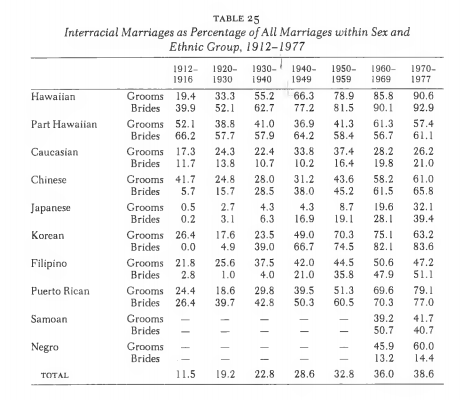
  • Differences between Chinese and Japanese assimilation. At least initially the Chinese were more willing to intermarry with the local populace.  Whereas the Japanese workers held out hope to return to Japan one day and marry someone from their village.  
2017-11-14_13-44-56.png
  • Very broad generalizations but the Chinese were the first to develop and integrate into the economy through business and trade whereas the Japanese were the first to integrate into the political scene.
  • Notably, the book doesn’t address the other large immigrant/worker populations such as the Filipinos, Koreans, and Puerto Ricans.  
  • Considerable remittances were paid back to homelands by the worker populations
  • There was a very wide variance in missionary experience in Hawaii’s history.  An interesting part of that covered in the book was that of their ministry to lepers on the island of Molokai.  

  • The genetic makeup in Hawaii is pretty interesting--what one might think of as a typical Hawaiian is likely nothing like a pure “Hawaiian” that first inhabited the islands.
  • Statehood was never a foregone conclusion for Hawaii.  There were a lot of “sugar” senators from the continental US that didn’t want the competition--the importance of sugar can’t be understated in the arc of Hawaii’s history..  Additionally, there was a fair amount of racism prevalent that sought to keep the “uncivilized” nation-state out of the Union.  
  • The Dole pineapple that we eat today only came after generations of experimentation and trial and error.  The history of the Hawaiian pineapple alone could fill a book.
  • Palm trees from Madagascar were brought in and planted in Kauai at some point.  This is noted in the book but I haven’t been able to find any other info to verify this on the interwebs.  


KEY REFERENCES:
Those seeking more robust scholarship on Hawaii’s history and it’s immigrant experience could explore the following articles and books:


Saturday, November 11, 2017

Kruse's Key: Read "Transit" to Understand the Tension Between Hatred and Yearning (Djibouti)

As you can probably guess there’s not exactly a ton of Djibouti fiction out there, especially en anglais.  But when it comes to Djibouti fiction, the author Waberi reigns supreme.  He’s written a lot to the extent where most of his novels have been translated from French to English.  


The translators, Dave and Nicole Ball, in particular, did a splendid job putting into English the patois of one of the narrators, an uneducated ex-soldier named Bashir.  The challenge to take french urban african slang and put it into English without making it sound like American urban slang is considerable but the Balls nailed it.

Transit interweaves Bashir’s story with that of Harbi (a member of the opposition intellectual elite) and his family.  While waiting at the Paris airport, the two men reveal their life stories as the narrative arc builds toward their intersection.  The novel’s plot is pretty well done so I won’t reveal much beyond what I mentioned thus far.

The staying power of this story comes from Waberi’s deft touch as he tackles the complexity of his country’s history and current political situation through the alternating monologues. This allows him to playfully jab at the idea of Djibouti’s democracy on one hand, calling it “that hot air of politicians who take bread from whoever giving it”, while also laud the Djiboutian people’s strength on the other with his admonition: “LET'S NOT FORGET that we never accepted the domination of the colonizers. Even when faced with a fait accompli and the law of the strongest, we resisted silently, secretly. Luckily, we had enough space to fall back on, unlike countries with greater population density like Burundi or Rwanda, where the Catholic church recorded its highest evangelization scores in the world. We could retreat into the brush, unseen and unheard. And above all, no official papers. Thus, what seemed to be the most generous acts of the administration, like the vaccination campaigns, were ignored if not massively rejected. Villages, schools, or cities—we rejected them. We preferred our rustic life.”

KEY QUOTES:
  • “Democracy, that hotair of politicians who take bread from whoever giving it.” (11)
  • “The president left with head of diplomacy to get the asshole general that used to be his true-true friend before, when they making restoration together. Together they knew how to conjugate the verb have, not the verb to be.” (12)
  • “I navigate easily between different languages, historical references, cultures, rumors from yesterday still warm today, and the oldest memories. Totally natural, I'm the product of love without borders; I'm a hyphen between two worlds.” (34)
  • “Poets approaching death commonly become prophets.” (44)
  • “LET'S NOT FORGET that we never accepted the domination of the colonizers. Even when faced with a fait accompli and the law of the strongest, we resisted silently, secretly. Luckily, we had enough space to fall back on, unlike countries with greater population density like Burundi or Rwanda, where the Catholic church recorded its highest evangelization scores in the world. We could retreat into the brush, unseen and unheard. And above all, no official papers. Thus, what seemed to be the most generous acts of the administration, like the vaccination campaigns, were ignored if not massively rejected. Villages, schools, or cities—we rejected them. We preferred our rustic life.” (54)
  • “The Angel gave the Prophet in a cave on Mount Hira. It said: “Iqrah! Recite!” From this verb comes the word Koran, recitation. At that time, reading, or recitation, was something very different from the present droning of the Word weakened by narrow minds, often bearded. Iqrah, recite and think by yourself, expand your knowledge; seek, in the bottom of your heart, the path that leads to The Unique.” (61)
  • “Africa would come to me all by herself, like a big girl. Alas, my little cactus, it was not the rebellious continent, just the Africa of news reports as they're filtered through the clear conscience of the West. Then it became the Africa of dictators with Swiss bank accounts, the Africa of rickety children and bony old men, the Africa of famine and the shameless looting of its resources, the Africa of squalid huts and gleaming white teeth, the Africa of landless people, the Africa of guerrillas and desperados.” (70)
  • “Since the beginning of time, we—that is, me and all my colleagues working in Guistir, the region of the three borders (Djibouti, Somalia, Ethiopia) that saw me born—haven't needed official documents to accompany that melody, to catch it at its birth, at the time when the cold desert night is separated from the reseda-yellow light of dawn. No member of our army of border guards, called ANG,1 has an authentic birth certificate; we were all “born circa…” Because nomadic time is not regulated by any calendar or encumbered by any archive, it does not sign the official papers demanded by the goatees of the Third Republic. Everybody was “born circa” in my time, and only the intrusion of the French colonial administration could impose such a delicate intention on us. For our own good, of course with some exceptional periods, like the English blockade under Churchill, which plunged the Territory, governed by the Vichy regime with an iron hand, into the depths of hunger and thirst. During that blockade, the people of this country tasted bitter roots and cat bouillon: the memory of that time is still tattooed on them to this day.” (98)
  • “Do not call me a mulatto, a métis. Metis was the first wife of Zeus, king of the Olympian gods. She died horribly.” (103)
  • “As I think of Him, I immediately open myself to Him, to pray serenely. To chant, with my eyes closed in ecstasy, the ninety-nine names of the very holy Prophet. That is how I regain peace of mind and body.” (111)

KEY TAKEAWAYS:
  • The section on the novel that mentions the lack of official documents rang especially true given my own experience in Comoros (p. 98).  During the beginning of my tour in Madagascar, when I was cutting travel orders for different Comorian military officers to train the US, I was dumbfounded to learn that so many them were born on 31 December. That is until one of them later shared with me that most of the older generation didn’t know the actual day they were born so they just picked a day, and most picked 31 December.  
  • One can’t underestimate the significance of France’s influence on most of its former colonies.  Its latent presence is embedded in the psyche of the countries’ citizens.  It manifests itself as both a hatred and a yearning--a hatred that France should still attempt to wield any influence but also a yearning as a place to which one could escape to a better life (yes, this is a vast oversimplification--I am just brainstorming here).

KEY PAIRING:
Jelloun's tragic Morocca tale Leaving Tangier; read my take on it here.

KEY REFERENCES:
Location: 45
The chapters in Transit are a succession of monologues by each of the characters in the novel: Bashir, a very young veteran of Djibouti's civil war; Harbi, a Djiboutian intellectual and an opponent of the regime; Harbi's French wife, Alice, and their son, Abdo-Julien; and Abdo-Julien's grandfather Awaleh.

Location: 49
One character gives us the same kind of pleasure we have in reading great tragicomic works of literature: Bashir, the poor, adolescent ex-soldier. His monologues are delivered in a slangy, comical language very much his own, a mix of naïveté and sly,

Location: 91
Waberi is one of the leading francophone writers of his generation, internationally recognized, one of those to whom the French novelist J. M. G. Le Clézio dedicated his Nobel Prize for Literature in his acceptance speech. Translated

Location: 96
for his latest novel, published in 2011, Passage des larmes (Passage of Tears),

Page: 6
people think migrants arrive naked in a new land at the end of their odyssey; yet migrants are loaded with their personal stories and heavier still with what is called collective history.

Page: 7
One day, as I was walking with my aunt along one of the avenues in our neighborhood, I passed by a military patrol. Like a chrysalis about to burst, the question popped out instantly: “Who are those people?” “The French, our colonizers.” “Why are they here?” “Because they're stronger than we are.”

Page: 8
I'm not afraid of nothing, not even foreigners (oh no! am I off my rocker or what? the foreigners, that's us now, the natives here, it's them).

Page: 11
Democracy, that hotair of politicians who take bread from whoever giving it.

Page: 12
Then, the president left with head of diplomacy to get the asshole general that used to be his true-true friend before, when they making restoration together. Together they knew how to conjugate the verb have, not the verb to be.

Page: 16
fauna; the tragic, camel-like swaying of its hips; the aquatic flora pictured on postage stamps; the desert islets like the famous Guinni Koma (also called l'île du Diable, Devil's Island by the French). I can feel its salt on my body. I am this pit like a wounded vulva between the hills. You'd think she was reading from a geography textbook. Yes, everything here is mine. The salt lakes, the bald peaks, the whimsical firmament at Lake Assal, the small forest from times long past, the limestone high plateaus, the Grand Bara and Petit Bara, the main summit culminating
at almost seven thousand feet. The bitter waters and their extraordinary salinity. The liquid heart of the gulf, its solitude crenellated with waves. Her world forever inviolable. This is my country stirring the air just like the lyre palm and the traveler tree dragging its exiles over the crust of the earth. My country running breathlessly, endlessly. My country sad and beautiful like the oilcloth of a village café in Brittany on a rainy Sunday morning. My dad and I would burst out laughing. She's stubborn and endearing. And there she goes now, changing the subject and the textbook. From geography to history. My country's history in the annals of the continent? Barely room for a lowly footnote at the bottom of a page. Seventy thousand square miles of hatred and misery, my country of ergs and acacias. She's flying off the handle now, excited as a young goat.

Page: 18
They'd laugh and joke in rhythm; they're sure good at that, bigger jokers you won't find.

Page: 23
African heads of state like so-so much Israeli bodyguards cause Israeli bodyguards they protect from military coup like rubber protect from AIDS you get me?

Page: 27
My mother, with her hair twisted together like those sentences of Monsieur Proust that no one can unravel, fears neither the sunburns that knock off foreigners with delicate skin nor the narrow little streets covered with dust. As a child I was fed on the milk of love, and reading.

Page: 31
To get back on subject. Oh yah I was saying: Wadags or not Wadags, not the problem. All that's politics, I'm telling you. In a lot of neighborhoods of the capital, in Einguela, Ambouli, Districts 1, 2, 4, Plateau, etc. Wadags, Walals, an Arabs, we all mixed, with plenty Hindis an even some Whites married to our girls, or just weirdos. And then, in the Dikhil district, between Wadags an the others it's fifty-fifty (that English, I speak it a little-little. Learned it when I worked in front of the American Embassy, I'll tell you about that later. I know how to talk English an that's that, OK?).

Page: 31
Problem is dirty tricks, corruption an politics. You know, Restoration!

Page: 34
Oum Kalsoum giving a masterly interpretation of Anta Oumri: sixty minutes of pure bliss.

Page: 34
I navigate easily between different languages, historical references, cultures, rumors from yesterday still warm today, and the oldest memories. Totally natural, I'm the product of love without borders; I'm a hyphen between two worlds.

Page: 35
Serge Gainsbourg's Dieu est un fumeur de havanes (“God is a smoker of Havanas”).

Page: 40
now it's haga* (that Djibouti summer, sun it hot lead melting on your skull, even the asphalt on the road yell mama mama I'm too-too melted). Haga, too fierce.

Page: 44
Poets approaching death commonly become prophets.

Page: 48
the same old stories of bloodshed, poisoned wells, kidnapped fiancées, raids on zebus, and vendettas between rival clans.

Page: 49
A baby face because it's only after they've reached forty-four that men here are fully entitled to be called an adult, your grandfather would have said in his gentle voice.

Page: 49
A sand-yellow territory on a sky-blue background, and all around it the four colonialists (France, Great Britain, Italy, and Ethiopia) who cut up the land of the sons of Samaale.

Page: 59
LET'S NOT FORGET that we never accepted the domination of the colonizers. Even when faced with a fait accompli and the law of the strongest, we resisted silently, secretly. Luckily, we had enough space to fall back on, unlike countries with greater population density like Burundi or Rwanda, where the Catholic church recorded its highest evangelization scores in the world. We could retreat into the brush, unseen and unheard. And above all, no official papers. Thus, what seemed to be the most generous acts of the administration, like the vaccination campaigns, were ignored if not massively rejected. Villages, schools, or cities—we rejected them. We preferred our rustic life.

Page: 59
got caught up in the game and first sent a little boy, some little orphan, to their school just out of curiosity. Then the youngest boy of the family, then the middle son, and finally the eldest, the keeper of the flock. But what could the children be doing all day? ventured the most skeptical. Faithful as the evening stars, they went to the same place every day, remaining seated, filling out little spiral notebooks with the district chief's stamp on them, and came back a few years later with a salary, without breaking their backs. Their fathers immediately opened up a store. From then on, they would rent out the donkey they used to lend. Little by little, they cut themselves off from their clan, spoke about their ancestors for no good reason, and were reluctant to give out alms. They shut themselves off from the others and saw only people like themselves, or passing foreigners like the nurse or the stationmaster, French from France or Greeks. And finally the truck driver replaced the camel driver, already threatened by the train.

Page: 61
the Angel gave the Prophet in a cave on Mount Hira. It said: “Iqrah! Recite!” From this verb comes the word Koran, recitation. At that time, reading, or recitation, was something very different from the present droning of the Word weakened by narrow minds, often bearded. Iqrah, recite and think by yourself, expand your knowledge; seek, in the bottom of your heart, the path that leads to The Unique.

Page: 69
The Théâtre des Salines is where we play for the working people of the neighborhoods.

Page: 70
Africa would come to me all by herself, like a big girl. Alas, my little cactus, it was not the rebellious continent, just the Africa of news reports as they're filtered through the clear conscience of the West. Then it became the Africa of dictators with Swiss bank accounts, the Africa of rickety children and bony old men, the Africa of famine and the shameless looting of its resources, the Africa of squalid huts and gleaming white teeth, the Africa of landless people, the Africa of guerrillas and desperados.

Page: 78
Dixit the Breton storyteller Maria Kermadec, who often concludes her ramblings with a proverb she attributes to a sailor from Cancale: “He who has words in his mouth can never get lost in the world.”

Page: 79
Abdo-Julien, that's me, stillborn in his seventeenth year, spirit wandering in the great tradition of the dibbuks you can find in The Golem, a small child returning periodically like the abikou* in the region of the Gulf of Guinea whose umbilical cord is buried next to Ilé-Ifé—an extraordinary fate, in the direct line of the shafeec* of our people. I owe everything I know to my parents. Does that surprise you?

Page: 87
And the little tree of memory, can you guess? The cactus. That's you, my little cactus.

Page: 97
The most gifted of us had the power to put the deepest song of the earth into words, wary of the small change of everyday words, a song that wells up from its belly, song of the slow crossing, a song unfolding to infinity.

Page: 98
Since the beginning of time, we—that is, me and all my colleagues working in Guistir, the region of the three borders (Djibouti, Somalia, Ethiopia) that saw me born—haven't needed official documents to accompany that melody, to catch it at its birth, at the time when the cold desert night is separated from the reseda-yellow light of dawn. No member of our army of border guards, called ANG,1 has an authentic birth certificate; we were all “born circa…” Because nomadic time is not regulated by any calendar or encumbered by any archive, it does not sign the official papers demanded by the goatees of the Third Republic. Everybody was “born circa” in my time, and only the intrusion of the French colonial administration could impose such a delicate intention on us. For our own good, of course with some exceptional periods, like the English blockade under Churchill, which plunged the Territory, governed by the Vichy regime with an iron hand, into the depths of hunger and thirst. During that blockade, the people of this country tasted bitter roots and cat bouillon: the memory of that time is still tattooed on them to this day.

Page: 100
They suffer under our sun. They die under our moon, knowing the extreme urgency of the creative act. They are from no place. They tell time. They tell destiny.

Page: 103
FALL 1892. They were exhibiting Ka'lina Amerindians from French Guyana completely naked in a Parisian park at the same time as our grandfathers in traditional dress, gathered in a flimsy hut indicating their generic name—Somalis—in the Zoological Garden of Acclimation. Take the Chemins de fer de l'Ouest, the Western Railroad, and get off at Porte Maillot station, said the poster announcing the attraction in all the French newspapers. All that memory is available with one little click.

Page: 103
“Do not call me a mulatto, a métis. Metis was the first wife of Zeus, king of the Olympian gods. She died horribly.”

Page: 111
As I think of Him, I immediately open myself to Him, to pray serenely. To chant, with my eyes closed in ecstasy, the ninety-nine names of the very holy Prophet. That is how I regain peace of mind and body.


Saturday, November 4, 2017

Kruse's Keys: Read 'Shop Class as Soulcraft' To Expand Your Notions of What "Work" Is (Crawford)

First let me caveat this review by saying that I listened to Shop Class as Soulcraft: An Inquiry Into the Value of Work (2009) as an audiobook and consequently didn't have the opportunity to take any notes or make highlights.  And with a book this dense, I'd normally be taking a lot of highlights.   While there was a lot of good and thoughtful information presented in this book many of the early chapters were too theoretical and philosophical for my taste.  If felt like a bit like I was listening to the literature review and background section of a thesis.  But then again, Crawford has a Ph.D. in philosophy so this deep dive is to be expected.


That said, I can’t recommend someone spend time reading this book in its entirety, rather I’d recommend you check it out from your local library and read Chapters 2, 6, and 8.  Truthfully, I expected the story of a think tank/academic Ph.D. turned motorcycle mechanic to be a bit more thrilling of a read.  Ultimately, if one can get past much of Crawford’s deep marxist philosophical discussion, there is much to be gleaned from his push back against the automatic glorification of higher level education versus acquisition of a trade or craft.  Whether admitted openly or not, society tends to looks down up the trades.  Crawford illustrates clear, however, the beauty and transcendent value of our plumbers, electricians, mechanics and craftsmen.  


KEY TAKEAWAYS:
  • The United States has gone from a country of ‘makers’ (i.e., tradesmen, inventors, creators) to cubicle automatons.  
  • Chapter 2: The Separation of Thinking From Doing
    • On college: Approach college by going deep into liberal arts and sciences in you have four years and a deep attraction for knowledge and learning but if not there’s still a wealth of “doing” jobs out there.
  • Chapter 6:  The Contradictions of the Cubicle
    • On the language of management as an indicator of the manipulation of the worker a la Soviet bureaucracy
    • The rise of teamwork and its link to corporate culture
    • The present corporate work culture and emphasis on office speech and things like diversity and sensitivity training arise in organizations that don’t produce a tangible product
    • Value and strength of the apprentice-master relationship
  • Chapter 8: Work, Leisure, and Full Management
    • US has clear separating functions of political power but has conversely allowed for consolidation of economic power.  
KEY QUOTES:
  • “When the point of education becomes the production of credentials rather than the cultivation of knowledge, it forfeits the motive recognized by Aristotle: "All human beings by nature desire to know.”
  • “A decline in tool use would seem to betoken a shift in our relationship to our own stuff: more passive and more dependent. And indeed, there are fewer occasions for the kind of spiritedness that is called forth when we take things in hand for ourselves, whether to fix them or to make them. What ordinary people once made, they buy; and what they once fixed for themselves, they replace entirely or hire an expert to repair, whose expert fix often involves replacing an entire system because some minute component has failed.”
  • l,; “The current educational regime is based on a certain view about what kind of knowledge is important: “knowing that,” as opposed to “knowing how.”
  • l“The rise of “teamwork” has made it difficult to trace individual responsibility,”


KEY REFERENCES:
Labor and Monopoly Capital: The Degradation of Work in the Twentieth Century:

KEY PAIRING: